
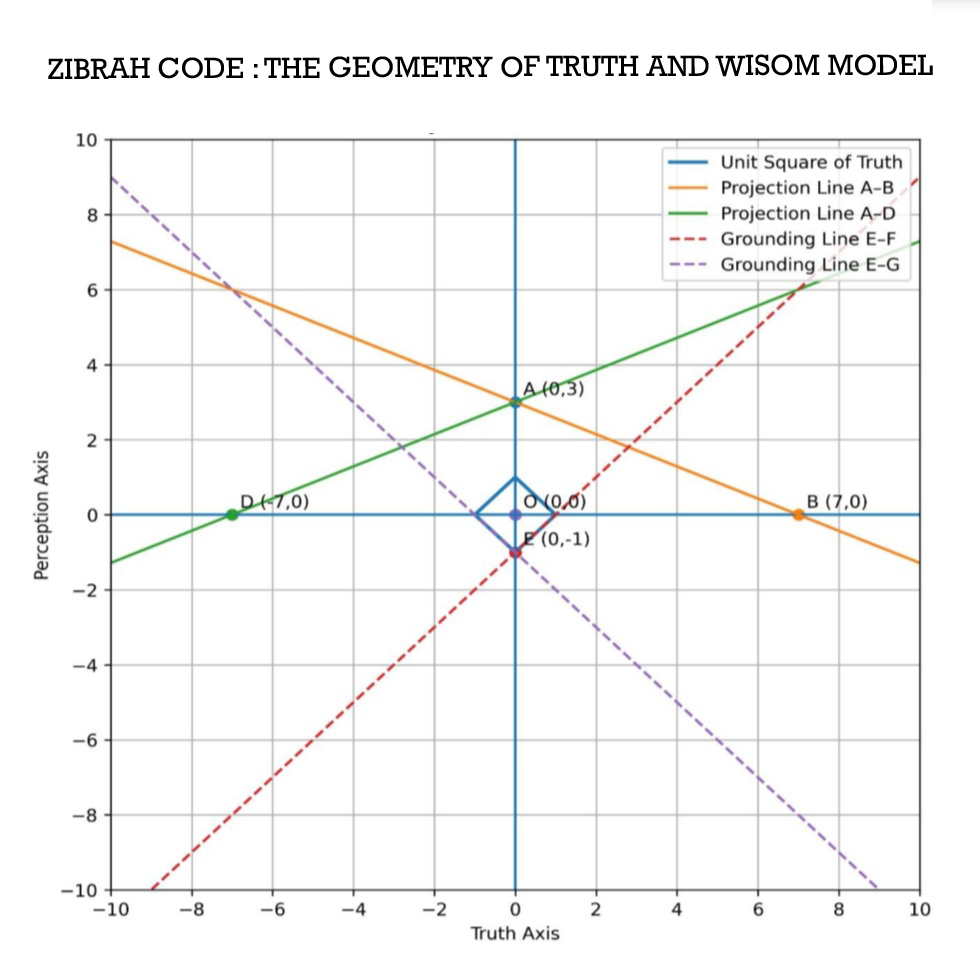
Every framework needs a shape. Zibrah Code's shape is deliberately simple: two independent lines, truth and perception, set at an angle to each other, not stacked, not merged.
Most models collapse truth and perception into a single axis, as if believing something harder makes it truer. Zibrah Code refuses that collapse. Truth stands on its own line. Perception stands on its own line. What happens between them, the angle, is where belief actually lives.
This separation is the entire foundation. Once truth and perception are treated as independent, their relationship becomes something that can be measured, not just argued about. A narrow angle signals rigid belief. A wide angle signals openness. Neither position is inherently right, but each is visible, and visibility is the beginning of correction.
The diagram that accompanies this structure is not decoration. It is the argument. Two dimensions, held apart, describe more about human disagreement than a thousand words of explanation could.
Every axiom that follows in the Zibrah Code framework, how belief forms, how extremes mirror each other, how wisdom differs from projection, descends directly from this one structural decision: keep truth and perception separate, and watch what moves between them.
Structure is not the whole of wisdom. But without it, wisdom has nowhere to stand.
Angles show what words cannot tell.
0 Comments
Be the first to share your perspective.
Sign in to join the conversation.