The Book
Zibrah Code™ · by Ibrahim Ngugi Gatimu
A new way to understand conflict, belief and leadership. Not through ideology, not through psychology alone. Through geometry.
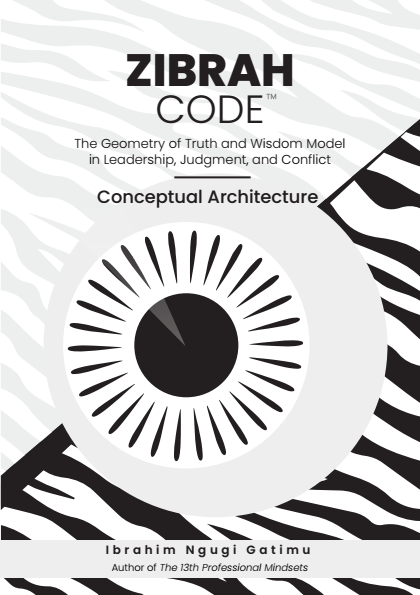
Truth and perception are held apart as two independent lines. What happens between them decides whether a conflict opens or closes.
The Zibrah Code introduces a geometric way of seeing how belief, judgment, and perception interact under pressure. By mapping movement between truth and perception, the model reveals why leadership decisions harden, why conflict escalates, and how stability can be restored before breakdown occurs.
Rather than treating truth and perception as a single sliding scale, the Zibrah Code holds them apart as independent dimensions. What happens between them, the angle, is where belief actually lives, and it is that angle, not the argument, that determines whether a conflict opens or closes.
The book builds its model from five structural statements, each one a move that most arguments skip.
Read the FrameworkTruth, in the Zibrah Code, is not treated as a possession or a prize. It is a claim, made and held independently of whoever is making it.
Perception is not truth arriving unfiltered. It is truth passed through interpretation. Two people can stand in front of the same claim and walk away with different angles, not because one of them is lying, but because interpretation is a separate axis entirely.
Belief is not truth and it is not perception. It is what forms in the angle between them. This is why belief can feel absolutely solid to the person holding it while remaining, structurally, a byproduct of two independent, movable dimensions.
Opposing positions that feel like polar opposites often share the same geometry: the same narrow angle, the same locked posture, just facing different directions.
Wisdom, in this framework, is not the ability to convince others of a position. It is the ongoing alignment between truth and perception, a discipline of keeping the angle open rather than forcing it toward a preferred conclusion.
The same tool reads a boardroom, a negotiation, or your own reaction to being contradicted.
01
See why decisions harden under pressure and how to keep a team’s options open long enough for correction to matter.
02
A structural, side-neutral way to read a conflict before anyone has to be declared right. The geometry is visible first.
03
Turn the same tool on yourself: observe your own angle before you react, and notice when a belief has stopped rotating.

Finance professional, author and social entrepreneur with two decades of leadership across East and Central Africa. Those years were spent inside organizations auditing complex systems, watching how belief actually moves under pressure. The Zibrah Code is the residue of that observation.
Also by the author
The 13th Professional
A blueprint for values-based professional excellence.
Zibrah Code™: The Geometry of Truth and Wisdom Model in Leadership, Judgment, and Conflict. English edition, sold through Amazon.
