The Framework
Two independent lines, truth and perception, set at an angle to each other, not stacked, not merged. Belief is what forms in the angle between them. Once the two are held apart, that angle becomes something that can be seen and measured, not just argued about.
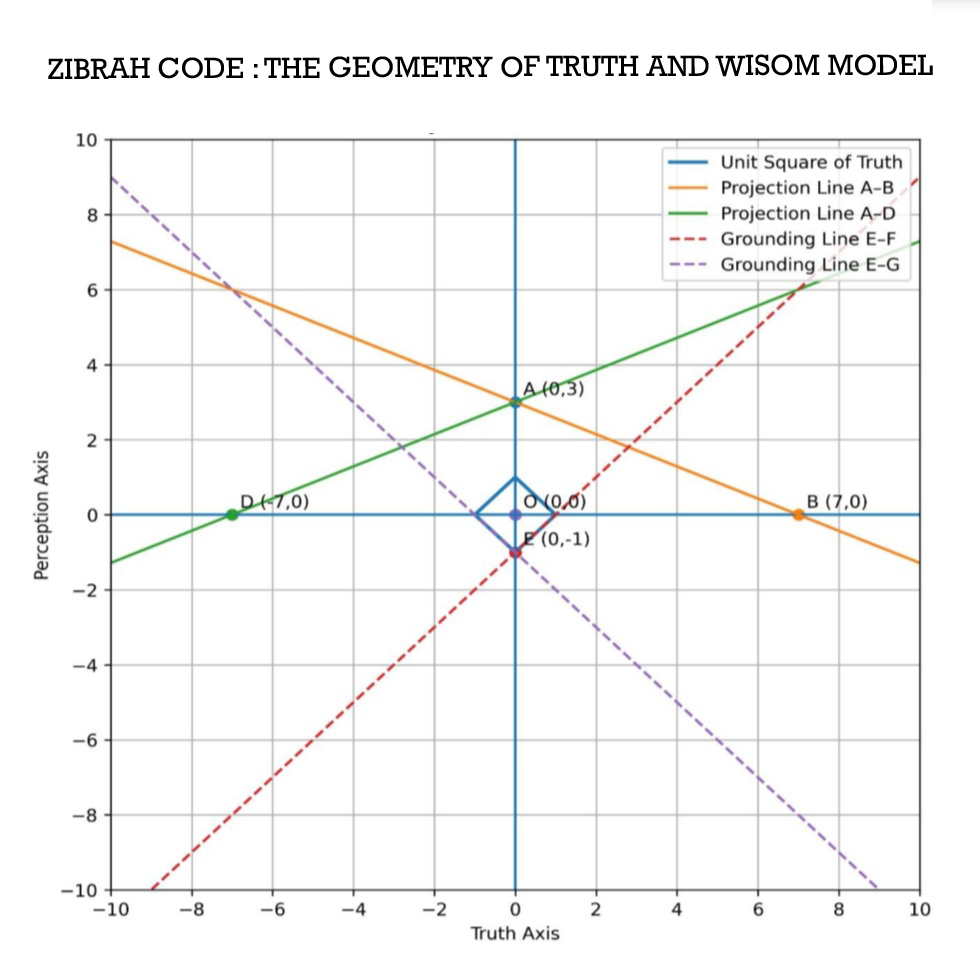
A wide angle signals openness. A narrow angle signals rigid belief. Neither position is inherently right, but each is visible, and visibility is the beginning of correction.
Wide angle
Belief stays responsive. Listening works, correction lands, disagreement is information rather than threat.
Narrowing angle
Certainty accelerates faster than understanding. Reality is still acknowledged but no longer obeyed.
Locked angle
Belief can no longer rotate. Facts remain, but correction is ineffective, not because facts disappear, but because nothing moves.
Each statement is a structural move that most arguments skip. Together they define the model’s logic.
Truth, in the Zibrah Code, is not treated as a possession or a prize. It is a claim, made and held independently of whoever is making it. Separating truth from the person asserting it is the first structural move the model requires, because it is the move most arguments skip.
Perception is not truth arriving unfiltered. It is truth passed through interpretation. Two people can stand in front of the same claim and walk away with different angles, not because one of them is lying, but because interpretation is a separate axis entirely.
Belief is not truth and it is not perception. It is what forms in the angle between them. This is why belief can feel absolutely solid to the person holding it while remaining, structurally, a byproduct of two independent, movable dimensions.
Opposing positions that feel like polar opposites often share the same geometry: the same narrow angle, the same locked posture, just facing different directions. The model reveals that certainty on either side of a conflict can be structurally identical.
Wisdom, in this framework, is not the ability to convince others of a position. It is the ongoing alignment between truth and perception, a discipline of keeping the angle open rather than forcing it toward a preferred conclusion.
The patterns are consistent across individuals, groups, institutions and societies. The question shifts from who is wrong to what stage has been reached.
01
Why decisions harden under pressure, and how to keep options open long enough for correction to matter.
02
A side-neutral way to read a dispute: the geometry is visible before anyone has to be declared right.
03
The same tool turned inward: observing your own angle before you react, and noticing when it has stopped rotating.
The axioms above are the skeleton. The book works through how belief forms, how extremes mirror each other, and how wisdom differs from projection.
